Educational content. This article does not replace consultation with a doctor or pelvic physiotherapist. For persistent symptoms or pre-existing conditions, seek professional guidance before starting any exercise routine.
There is a night almost every man knows. The desire is there, the willingness is there, but the body does not follow. And your head knows why: it was a heavy day, an overdue bill, a conversation that has been looping since the afternoon.
That is not a lack of attraction, and it is not a sign that something broke. It is physiology. The same system that prepares your body to react to a threat shuts down whatever it considers optional in that moment, and erection is on that list. Here you will see what science has already measured about stress, cortisol and erectile function, and how Ritmo uses pelvic floor training to give your body a trained response for exactly the moments when your head speeds up.
Stress and sexual performance, the direct answer
Direct answer
Stress hurts male sexual performance through two routes at once. On the hormonal route, high cortisol lowers testosterone production by acting directly on the testis. On the nervous route, sympathetic dominance keeps the smooth muscle of the penis contracted and makes it harder for the corpora cavernosa to fill. Erection depends on parasympathetic dominance, meaning a body that can step out of alert mode.
How to train this in practice
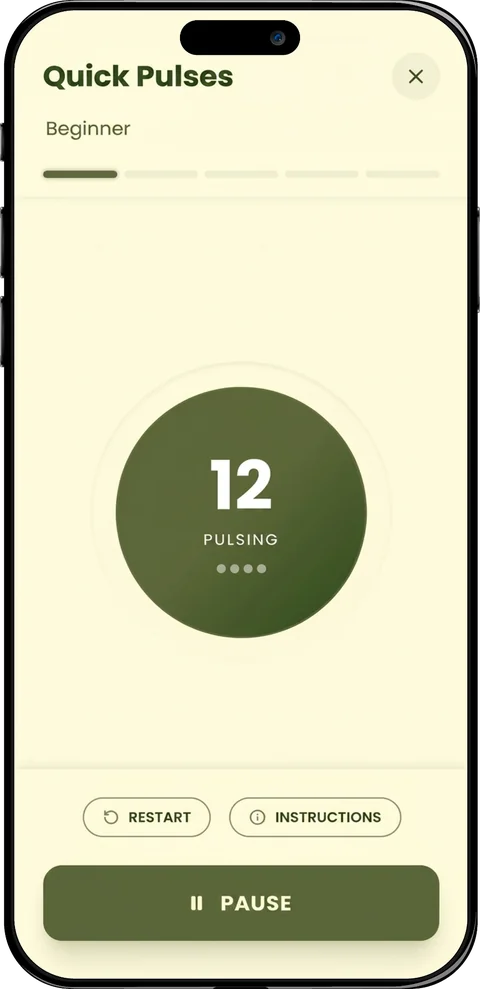
To bring what the science shows into your routine, the simplest route is guided pelvic floor training. Ritmo, a guided training app for iPhone and Android, shows on screen when to contract, hold and release, vibrates at every phase change and builds a 5 to 10 minute daily plan from a quick questionnaire. It is on the App Store and Google Play.
What cortisol does to testosterone
Cortisol is the hormone your body releases when it decides there is a threat to handle. It mobilizes energy, speeds up the heart and prioritizes whatever matters for the next hour. Reproduction is not on that priority list, and the blood shows it.
A direct drop at the testis
When circulating cortisol rises, whether through induced hypoglycemia or through hydrocortisone administration, serum testosterone falls quickly. And it falls without LH, the hormone the brain uses to signal the testis, changing at all. That points to cortisol suppressing testosterone by acting directly on the testis, not through an order coming from above.
Cumming DC, Quigley ME, Yen SSC. Acute Suppression of Circulating Testosterone Levels by Cortisol in Men. Journal of Clinical Endocrinology and Metabolism. 1983; 57(3):671-673. DOI: 10.1210/jcem-57-3-671
This adrenal-testicular axis may have biological implications for reproductive adaptation to stress. Cumming DC, Quigley ME, Yen SSC. Acute Suppression of Circulating Testosterone Levels by Cortisol in Men. Journal of Clinical Endocrinology and Metabolism. 1983.
One isolated cortisol spike after a tense meeting does not knock down testosterone in any lasting way. The problem is stress that never ends: months of high cortisol mean months of compressed hormone production, and libido is usually the first thing a man notices slipping.
Your head takes down your body through the nervous system, not only through the hormone
If cortisol explained everything, measuring the hormone would be enough to predict who struggles. That is not what the data shows. In men with erectile dysfunction of psychogenic origin, meaning no identified vascular or hormonal cause, what stands out is an imbalance in the autonomic nervous system.
8.40 versus 23.12
were the average erectile function scores on the IIEF-5 questionnaire between 75 men with psychogenic erectile dysfunction and 75 healthy men. The dysfunction group also reported far more perceived stress and showed a raised LF/HF ratio in heart rate variability, a marker of sympathetic dominance. Cortisol levels, however, did not differ between the groups.
Xu J, Chen Y, Gu L, et al. Hypothalamic-pituitary-adrenal axis activity and its relationship to the autonomic nervous system in patients with psychogenic erectile dysfunction. Frontiers in Endocrinology. 2023; 14:1103621. DOI: 10.3389/fendo.2023.1103621
It helps to separate the two. Cortisol tells the story of months of wear. What happens in that specific moment, with the person you want next to you, is autonomic balance: a body on alert does not enter the state erection requires. And autonomic balance shifts with breathing and with training, which are things you do, not things you wait for.
The role of breathing
The fastest way to move the autonomic nervous system is through your breath. A long exhale and a loose diaphragm push the body toward the parasympathetic side. Holding your breath does the opposite, and it also gets in the way of the pelvic contraction. Worth reading: breathing and the pelvic floor to see why the two always work together.
Performance anxiety is a loop, not a defect
One isolated failure turns into memory. The next time, part of your attention leaves the scene and goes to monitoring your own body. That monitoring is, by definition, a state of alert, and alert is exactly what blocks the response. The loop feeds itself.
20.0%
is the median prevalence of erectile dysfunction in men with anxiety disorders, in a systematic review of 12 studies selected out of 1,220 articles. The median IIEF-5 score in that group was 17.62, in the mild to moderate severity range.
Velurajah R, Brunckhorst O, Waqar M, McMullen I, Ahmed K. Erectile dysfunction in patients with anxiety disorders: a systematic review. International Journal of Impotence Research. 2022; 34:177-186. DOI: 10.1038/s41443-020-00405-4
Clinical anxiety and everyday stress are not the same thing, but the mechanism looks alike. The more a man watches his own response, the less it shows up. Getting out of that loop rarely comes from trying to relax by willpower. It comes from changing what the body does by default.
Why pelvic floor training helps men who live tense
The pelvic floor is the voluntary muscular part of this story. The ischiocavernosus and the bulbocavernosus compress the base of the penis and help hold pressure inside the corpora cavernosa. When they are strong and under conscious control, the physical response depends less on everything being perfect in your head.
75.5%
of men with erectile dysfunction (3 in 4) improved their erections with pelvic floor training, and 40% (4 in 10) regained normal erections within 6 months, in a randomized clinical trial with 55 participants.
Dorey G, Speakman M, Feneley R, Swinkels A, Dunn C. Pelvic floor exercises for erectile dysfunction. BJU International. 2005; 96(4):595-597. DOI: 10.1111/j.1464-410X.2005.05690.x
82.5%
of men with lifelong premature ejaculation gained ejaculatory control after 12 weeks of pelvic floor training and more than quadrupled the duration of intercourse.
Pastore AL, Palleschi G, Fuschi A, et al. Pelvic floor muscle rehabilitation for patients with lifelong premature ejaculation: a novel therapeutic approach. Therapeutic Advances in Urology. 2014; 6(3):83-88. DOI: 10.1177/1756287214523329
One important caveat for men who live tense: chronic stress usually comes with too much pelvic tension, not with weakness. In those cases, contracting more makes it worse. What is missing is learning to let go, which is what the reverse Kegel is for. If firmness is your focus, also see which exercises science backs for erectile dysfunction .
How Ritmo applies this in practice
Ritmo does not treat stress. What it does is train the part of the system that answers to a voluntary command, so that part does not depend on you being calm.
- Guided training, visual and by vibration. During the exercise the screen shows the time and the phase, contract, hold, release, rest, with the vibration following along. You follow the pace instead of counting on your own, and the attention cost drops.
- Sessions of 5 to 10 minutes. Short enough to fit into a bad day, which is exactly when routines usually break.
- Session A and Session B. A works strength and endurance, B works control and coordination. Both carry the same weight in the program, and the control side is the one that matters most to men who feel their head running over their body.
- Explicit release phases. Relaxation gets its own time inside the session, with pulses that slow down to guide the release. It is not leftover time, it is part of the work.
- Automatic progression and rest days. The load goes up on its own as you advance, and rest is scheduled. You do not have to decide anything on a day already full of decisions.
- Discreet icon. The app does not announce what it is on your phone's home screen.
If you want to calibrate the volume before starting, it is worth checking how many Kegel repetitions per day make sense. More is not better, and overtraining during a stressful stretch tends to add the tension you were trying to reduce.
Frequently asked questions
Can stress cause erectile dysfunction?
Yes. Stress acts through two routes. High cortisol lowers testosterone production by acting directly on the testis, and sympathetic dominance keeps the smooth muscle of the penis contracted, which makes it harder for the corpora cavernosa to fill. In men with psychogenic erectile dysfunction, the marker that stands out most is precisely this autonomic imbalance.
How long does high cortisol take to affect testosterone?
In the study by Cumming and colleagues (1983), a rise in circulating cortisol was followed by a rapid fall in serum testosterone, with no change in LH. An isolated spike has no lasting effect. What matters is chronically high cortisol, because it means months in a row of compressed hormone production.
Is there treatment for performance anxiety?
There is, and it usually combines approaches. The systematic review by Velurajah and colleagues (2022) found a median prevalence of 20% for erectile dysfunction among men with anxiety disorders, which justifies professional assessment. Alongside that, pelvic floor training and diaphragmatic breathing work on the physical side of the loop, reducing how much your body's response depends on you being calm.
Do Kegel exercises help men with chronic stress?
They do, with one important caveat. Men who live tense usually have excess pelvic tension rather than weakness, and in that case contracting more makes things worse. Training has to include active release phases, the so called reverse Kegel, alongside the contractions. Ritmo already builds those release phases into every session.
Does deep breathing improve erection in the moment?
Breathing is the fastest way to shift the autonomic nervous system toward the parasympathetic side, which is the state erection requires. A long exhale with a loose diaphragm helps. Holding your breath does the opposite and also interferes with the pelvic contraction, which is why guided training always tells you to keep breathing naturally.
Is there an app to improve sexual performance naturally?
Yes. Ritmo is a guided male pelvic floor training app for iPhone and Android, based on clinical studies. To bring what the science shows into your routine, the simplest route is guided pelvic floor training. It builds the plan around your goal, guides each 5 to 10 minute session and tracks your progress. It is on the App Store and Google Play. It does not replace medical care.
Conclusion
Stress affects sexual performance through two routes that have already been measured: high cortisol compressing testosterone right at the testis, and a nervous system on alert blocking the response erection requires. Neither one is a character flaw, and neither one obeys an order to relax.
What you can build instead is a trained physical response, one that does not depend on the day having gone well. Ritmo guides that part: 5 to 10 minutes a day, with automatic progression and release phases, so your body has something to offer even when your head is full.