Educational content. This article does not replace consultation with a doctor or pelvic physiotherapist. For persistent symptoms or pre-existing conditions, seek professional guidance before starting any exercise routine.
You know the scene. Two or three drinks to loosen things up, and when it actually matters the body does not follow. The next morning the question sits there: was it the alcohol, was it exhaustion, or is something wrong?
Alcohol and erection have two separate stories, and almost all the confusion comes from mixing them. One is what happens on the night itself, measured in a lab with blood alcohol under control. The other is what a drinking habit does over years, measured in studies with hundreds of thousands of men. They point in opposite directions, and both are right. Below: what each one measured, where exactly the curve turns, and what Ritmo does with the part that stays under your control even on a night out.
Alcohol and erection, the direct answer
Direct answer
On the night itself, alcohol's effect on erection depends on the dose and turns early. In the Farkas and Rosen study, the largest penile response appeared at the lowest blood alcohol level tested, 0.025%, with marked suppression from 0.05% upward. For habitual drinking, meta-analyses find no increased risk of erectile dysfunction among light to moderate drinkers, but the apparent benefit disappears above 21 drinks per week.
On the night itself, the curve turns early
Alcohol is a central nervous system depressant. In small amounts, what it does usefully is take the brake off: less self criticism, less watching your own body. But the same substance that loosens the head also depresses the nerve pathway that has to reach the penis. Both effects live in the same glass, and the second one grows faster.
0.025%
was the blood alcohol concentration at which 16 young men showed the largest increase in penile diameter, across the three doses tested. From 0.05% upward there was marked suppression of the response. So the peak was not at zero, but it was not far from it either: doubling the concentration was enough to turn the effect against them.
Farkas GM, Rosen RC. Effect of alcohol on elicited male sexual response. Journal of Studies on Alcohol. 1976; 37(3):265-272. DOI: 10.15288/jsa.1976.37.265
That number is worth reading carefully, because it is not a count of drinks. Blood alcohol depends on your weight, on how much you ate, on how fast you drank and on how your liver works. The same pair of beers can leave two men in very different ranges. What the study gives you is the shape of the curve, not a recipe: the window where alcohol still works in your favor is narrow, and it closes long before you feel drunk.
In practice, that explains the experience behind the opening scene. The dose that loosened the conversation and the dose that shut down the physical response usually happen on the same night, separated by very little.
Habitual drinking tells a different story
If alcohol knocks down the response in the moment, intuition says frequent drinkers should have more erectile dysfunction. Epidemiology does not confirm that. And the result is consistent enough to show up in more than one meta-analysis.
0.71
was the odds ratio for erectile dysfunction among men with light to moderate alcohol intake, under 21 drinks per week, compared with non drinkers (95% confidence interval: 0.59 to 0.86). At high intake, above 21 drinks per week, the ratio was 0.99, meaning no difference at all. The analysis pooled 24 studies and 154,295 participants, and the relationship found was non linear.
Wang XM, Bai YJ, Yang YB, Li JH, Tang Y, Han P. Alcohol intake and risk of erectile dysfunction: a dose-response meta-analysis of observational studies. International Journal of Impotence Research. 2018; 30(6):342-351. DOI: 10.1038/s41443-018-0022-x
0.79
was the odds ratio for erectile dysfunction associated with regular alcohol consumption in an earlier meta-analysis of 11 cross-sectional studies (99% confidence interval: 0.67 to 0.92). The authors themselves record the limit of the finding: the two cohort studies they reviewed showed no significant association, and the result lost strength once the analysis used the International Index of Erectile Function definition.
Cheng JYW, Ng EML, Chen RYL, Ko JSN. Alcohol consumption and erectile dysfunction: meta-analysis of population-based studies. International Journal of Impotence Research. 2007; 19(4):343-352. DOI: 10.1038/sj.ijir.3901556
Why those numbers are not permission to drink
An Australian population based study helps explain what sits behind that inverted association. It compared never drinkers, current drinkers, weekend drinkers, binge drinkers and ex drinkers.
Ex drinkers
were the only group with higher age adjusted odds of erectile dysfunction than never drinkers. Every group that drank came in below them. Among current drinkers, the lowest odds appeared in the range of 1 to 20 drinks per week. And once the analysis also adjusted for cardiovascular disease or for smoking, the odds among drinkers dropped a further 25% to 30%.
Chew KK, Bremner A, Stuckey B, Earle C, Jamrozik K. Alcohol consumption and male erectile dysfunction: an unfounded reputation for risk? The Journal of Sexual Medicine. 2009; 6(5):1386-1394. DOI: 10.1111/j.1743-6109.2008.01115.x
The findings suggest a modest negative association between alcohol consumption and erectile dysfunction, with confounding by cardiovascular disease and cigarette smoking. Chew KK, Bremner A, Stuckey B, Earle C, Jamrozik K. Alcohol consumption and male erectile dysfunction: an unfounded reputation for risk? The Journal of Sexual Medicine. 2009.
The ex drinkers are the most important clue in the whole set. Plenty of people stop drinking because they got sick, not the other way around. Once that group lands in the count, the non drinking side fills up with men who already have health problems, and any comparison with drinkers starts out crooked. Add that all of this data is cross-sectional, captured at a single moment, and the picture is clear: it shows who drinks and who has erectile dysfunction at the same time, not who developed what because of what.
The honest reading is modest and still worth something: light to moderate drinking does not show up as a risk factor for erectile dysfunction in the population literature. Turning that into permission to drink more is a long leap. None of these studies tested alcohol as a treatment, and none followed the same men over time.
So how much is too much
There is no single number that works for everyone, and be suspicious of anyone who hands you one. What the data supports is four signals.
- On the night that matters, less is more. Alcohol's useful effect is taking the brake off your head, and that is already available at a low concentration. What comes after is depression of the physical response, and it shows up before you feel noticeably drunk.
- As a habit, excess buys you nothing. Above 21 drinks per week the favorable association vanishes completely in the data. Heavy drinkers do not even get the apparent benefit that moderate drinkers get.
- Concentrating it is not the same as spreading it. Seven drinks on Saturday and seven drinks across the week add up to the same total and do not produce the same night. What knocks down the erection is the blood concentration at that moment.
- If it only fails when you drink, alcohol is the trigger. If it also fails sober, alcohol has become a convenient explanation for something that deserves a medical assessment.
Worth remembering that alcohol rarely shows up alone. It tends to appear on exactly the nights of accumulated exhaustion and pressure, and a nervous system stuck on alert already knocks the response down on its own. Men on medication need extra care, because alcohol and tadalafil act on the same vessels, and no pill reverses the nervous depression the drink caused.
What stays under your control
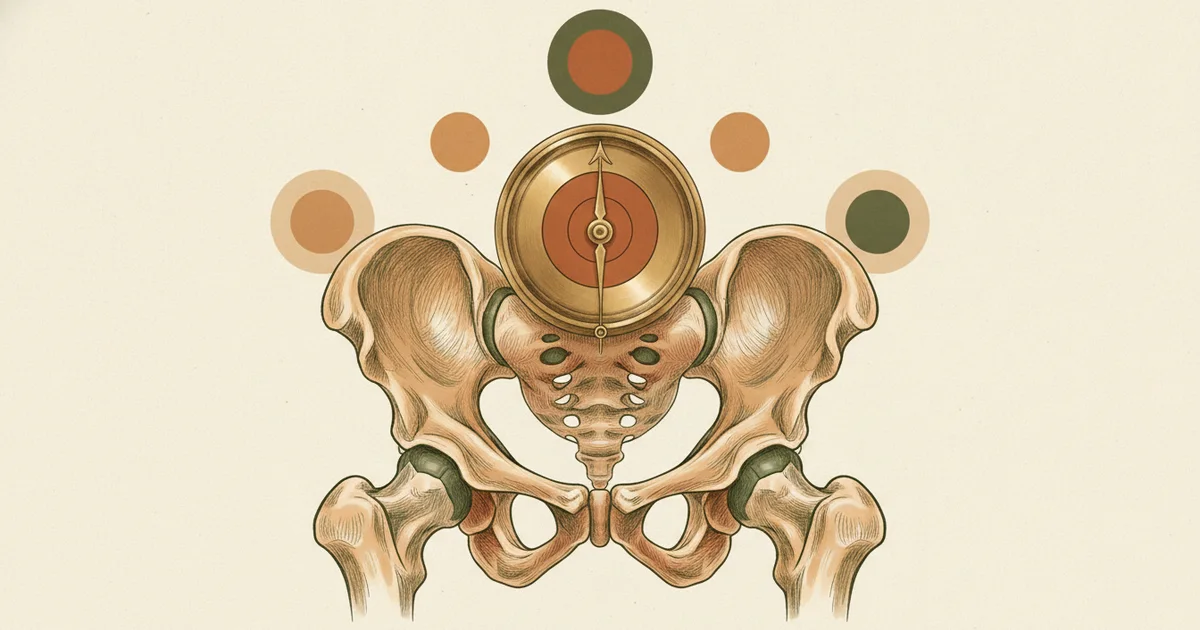
There is a part of this story that does not depend on how dinner went. Erection is not just blood filling: holding pressure inside the corpora cavernosa depends on voluntary pelvic floor muscles, the ischiocavernosus and the bulbocavernosus, which compress the base of the penis. That is the one piece of the system that responds to direct training.
75.5%
of men with erectile dysfunction showed significant improvement in rigidity after 3 months of pelvic floor exercises, in a randomized clinical trial with 55 participants.
Dorey G, Speakman M, Feneley R, Swinkels A, Dunn C. Pelvic floor exercises for erectile dysfunction. BJU International. 2005; 96(4):595-597. DOI: 10.1111/j.1464-410X.2005.05690.x
Trained muscle does not cancel out a heavy night, and it would be a lie to say it does. What it does is widen the margin: the stronger and the more consciously controlled that muscle is, the less the response depends on everything being perfect. If firmness is your focus, it is worth reading which exercises the science supports for erectile dysfunction .
How Ritmo applies this in practice
Ritmo has nothing to say about your drinking. What it does is train the muscular part of the response, which is where the effort has measured returns.
- Guided training, visual and by vibration. During the exercise the screen shows the time and the phase, contract, hold, release, rest, with vibration following along. You follow the rhythm instead of counting on your own.
- Sessions of 5 to 10 minutes. That is the range used in the clinical protocols, short enough to fit into any day.
- Session A and Session B. A works strength and endurance, B works control and coordination. Both carry the same weight in the program.
- Automatic progression and rest days. The load rises as you advance, and rest is scheduled. You do not have to decide anything.
- Train wherever you want, with a discreet icon. The exercises are internal, nobody notices, and the app does not announce what it is on your home screen.
Frequently asked questions
Does a drink beforehand help or hurt erection?
It depends on the dose, and the useful window is narrow. In the Farkas and Rosen study, the largest penile response appeared at the lowest blood alcohol level tested, 0.025%, and from 0.05% upward there was marked suppression. What alcohol does well is take the watchfulness out of your head. What it does badly is depress the nerve pathway that has to reach the penis, and that second effect grows faster.
How much alcohol is too much for erection?
There is no universal number, because blood concentration depends on weight, food, drinking speed and metabolism. What the data shows is that, for habitual drinking, above 21 drinks per week the favorable association found in meta-analyses disappears entirely. And that concentrating the drinks into a single night matters more for that night than the weekly total does.
Does alcohol cause permanent erectile dysfunction?
Population studies do not show light to moderate drinking as a risk factor for erectile dysfunction. In a meta-analysis of 24 studies and 154,295 participants, intake below 21 drinks per week had an odds ratio of 0.71. That data is cross-sectional and carries known confounding, so it does not prove cause in either direction. A failure that persists without alcohol deserves a medical assessment.
Why do ex drinkers have more erectile dysfunction than never drinkers?
Because plenty of people quit drinking after getting sick, not the other way around. This is known as the sick quitter bias. In the Australian study by Chew and colleagues, ex drinkers were the only group with higher odds of erectile dysfunction than never drinkers, which helps explain why current drinkers appear to be at an advantage in these surveys.
Do Kegel exercises help men who drink socially?
They help, but through a different route. Training does not neutralize the effect of a heavy night. It works on the voluntary muscles that hold pressure inside the corpora cavernosa, the ischiocavernosus and the bulbocavernosus. In the trial by Dorey and colleagues, 75.5% of men with erectile dysfunction improved their rigidity after 3 months of pelvic floor exercises.
Conclusion
The two alcohol stories do not contradict each other, they answer different questions. On the night itself there is a narrow window where the drink helps by loosening the head, and it closes early: from 0.05% blood alcohol upward the physical response was already markedly suppressed in the lab. As a habit over years, light to moderate drinking does not appear as a risk factor in population data, with the caveat that this data carries known confounding and does not prove cause.
What you can actually do with this sits less in the glass and more in the margin you build before it. Ritmo guides that part with sessions of 5 to 10 minutes, automatic progression and release phases, so your body's response depends less on the night having been perfect.