Educational content. This article does not replace consultation with a doctor or pelvic physiotherapist. For persistent symptoms or pre-existing conditions, seek professional guidance before starting any exercise routine.
After a radical prostatectomy, two questions dominate the conversation in the doctor's office: when urinary control comes back, and whether erections come back. Almost every urologist mentions pelvic floor exercises at discharge, sometimes with a printed handout, sometimes as a single sentence buried in a list of other instructions. What usually goes unsaid is the rest: what exactly to do, when to start, and what to expect.
This article gathers what clinical trials show about pelvic floor training after prostate surgery. Where the evidence is solid, where it is split, and where it is still thin. The numbers come from four randomized studies published in urology journals. It is the same foundation behind the training in Ritmo, with one caveat worth stating up front: anyone who has had surgery trains with medical clearance and follow-up, not on their own.
Direct answer: what the science recommends
Direct answer
Pelvic floor training speeds up the return of continence after radical prostatectomy, and that is the indication with the strongest evidence. It starts right after the catheter comes out, with quality contractions guided by a professional, and continues for months. For erections, the signal exists but comes from smaller studies. Starting before surgery is the point where the trials disagree.
Why the pelvic floor becomes the main structure in charge
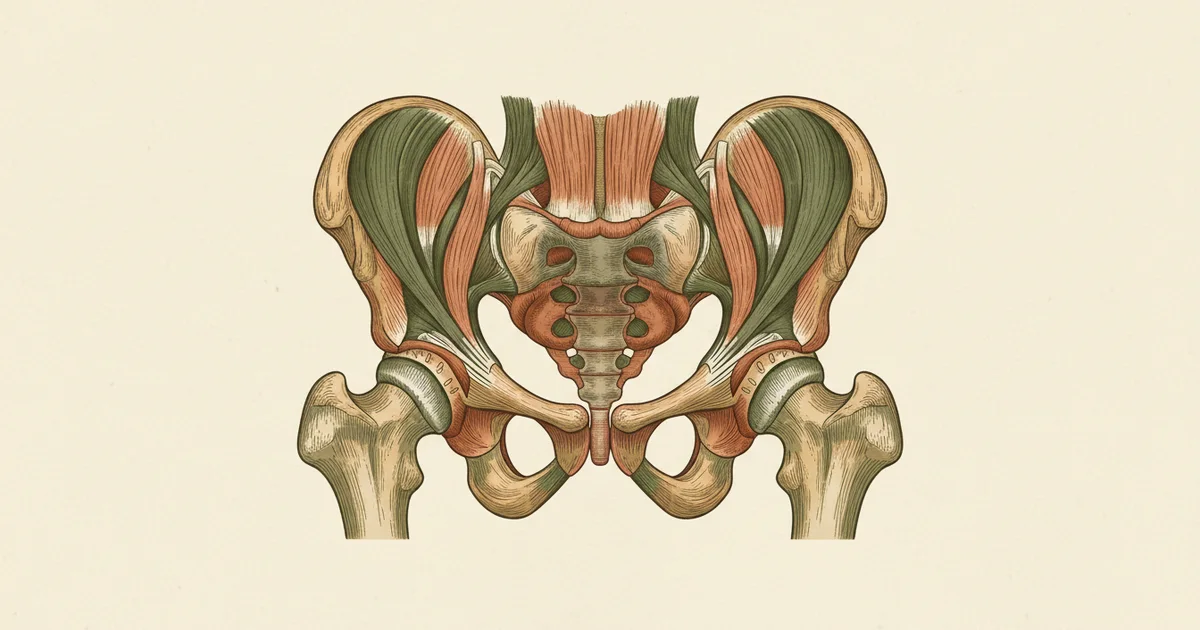
Male continence rests on two mechanisms. The first is the internal sphincter, involuntary, located at the bladder neck and anatomically tied to the prostate. The second is the external sphincter, or rhabdosphincter, which you control on purpose and which works together with the pelvic floor muscles.
Radical prostatectomy removes the prostate and, with it, much of the first mechanism. What is left to hold urine is precisely the second one, the voluntary one, the same one Kegels train. It is no coincidence that the exercise appears in practically every recovery protocol: it acts on exactly the structure that was left alone with the job.
With erections, the logic is different and more limited. The neurovascular bundles that drive erection run right alongside the prostate and can be affected during surgery, even with nerve-sparing technique. The ischiocavernosus and bulbocavernosus muscles raise the pressure inside the corpora cavernosa when they contract, which helps maintain firmness, but no muscle replaces a damaged nerve. That is why the gain in erectile function shows up in studies with smaller numbers and less consistency than the gain in continence.
The strongest evidence is about continence
The most cited trial in this area followed 300 men who had undergone radical retropubic prostatectomy, split into two groups of 150. One received structured guidance on pelvic floor exercises right after the catheter came out, before discharge. The other received only the generic verbal instruction to contract the muscles.
94.6% versus 65%
at six months, that was the difference in continence between the men who did guided early rehabilitation and those who did not. The gap already showed up in the first month: 19% versus 8%. The exercise did not change the final outcome for most men, it changed how fast control came back. In practice, that means months less time in pads.
Filocamo MT, Li Marzi V, Del Popolo G, et al. Effectiveness of early pelvic floor rehabilitation treatment for post-prostatectomy incontinence. European Urology. 2005;48(5):734-738. DOI: 10.1016/j.eururo.2005.06.004
Two things about that design deserve attention. The first is "early": the training began as soon as the catheter came out, not months later, once the man had already gotten used to living with the leakage. The second is "guided". Both groups heard about Kegels. Only one learned to do them with supervision, correction and a plan. What the study measured is the difference between knowing the exercise exists and knowing how to perform it.
Training before surgery: this is where the studies disagree
The idea makes sense at first glance: learn to contract the muscle while everything still works, so you arrive at surgery with the skill ready. Two randomized trials tested this and reached different conclusions.
44.1% versus 20.3%
continent in the first month after surgery, comparing men who started training 30 days before the procedure with men who only started afterward. At three months the advantage held: 59.3% versus 37.3%. The trial randomized 118 men into two groups of 59.
Centemero A, Rigatti L, Giraudo D, et al. Preoperative pelvic floor muscle exercise for early continence after radical prostatectomy: a randomised controlled study. European Urology. 2010;57(6):1039-1044. DOI: 10.1016/j.eururo.2010.02.028
Three years later, a Belgian group ran the test with almost twice as many participants and did not find the same effect.
30 days versus 31 days
was the median time to continence between men who trained both before and after surgery and men who trained only afterward. Across 180 men, the difference was not statistically significant. Preoperative training did produce quality of life gains at three and six months, but it did not bring urinary control back any sooner.
Geraerts I, Van Poppel H, Devoogdt N, et al. Influence of preoperative and postoperative pelvic floor muscle training on urinary incontinence after radical prostatectomy: a randomized controlled trial. European Urology. 2013;64(5):766-772. DOI: 10.1016/j.eururo.2013.01.013
How do you read two opposite answers without simply picking the one you like? Look at what both studies have in common: in both, everyone trained after surgery, and in both, the preoperative group learned the technique beforehand. What the Belgian study suggests is that the benefit of the preoperative period lies more in the learning than in any extra strength banked ahead of time. Training beforehand is unlikely to hurt, and arriving at surgery already able to find and contract the right muscle removes a step that is hard to complete while wearing a pad and sore from the operation.
What about erections after prostatectomy?
Here the evidence is thinner, but it is not zero. A Brazilian trial randomized 52 men who had had surgery into two groups: one did pelvic floor training with biofeedback right after the procedure, the other did not. Potency was measured with the IIEF-5, the standard erectile function questionnaire, over twelve months of follow-up.
47.1% versus 12.5%
recovery of potency at twelve months, favoring the group that did pelvic floor training with biofeedback in the immediate postoperative period. The sample is small, 52 men in total, which calls for caution, but the direction of the result matches what is known about the pelvic muscles' role in erectile firmness.
Prota C, Gomes CM, Ribeiro LS, et al. Early postoperative pelvic-floor biofeedback improves erectile function in men undergoing radical prostatectomy. International Journal of Impotence Research. 2012;24(5):174-178. DOI: 10.1038/ijir.2012.11
It is worth saying what the study does not say. It does not show that Kegels restore erections in men whose nerves were damaged, and it does not replace the penile rehabilitation a urologist prescribes, medication included. What it indicates is that training the muscles improves the part of the mechanism that depends on muscle. The full reasoning behind that vascular piece is in erectile dysfunction and exercise.
What this means in practice
Putting the four studies together, a few points repeat and work as general guidance, always subordinate to whatever your doctor decides.
- Wait for the catheter to come out and for your team to clear you. Contracting the muscles with the catheter in place is not part of any of the protocols cited here.
- Start early after that. The gain in these studies is in the speed of recovery, and speed is exactly what you lose when training starts months later.
- Make sure you are contracting the right muscle. Glutes, abs and thighs join in easily and give a false sense of effort. How to check this is in how to know if you are contracting the right muscle.
- Do not use the urine stream as an exercise. Stopping the stream works at most as a one-off identification test and, repeated, interferes with emptying the bladder.
- Release completely between one contraction and the next. A muscle that stays permanently tense is not a strong muscle, and the release is part of the repetition.
- Think in months, not days. In these studies, the gap between groups kept widening at three and six months. What changes at each stage is covered in how long it takes to see results with pelvic exercises.
How Ritmo applies this in practice
First, the honest note: Ritmo is guided pelvic floor training for men, not a post-surgical rehabilitation protocol. Anyone who has had a prostatectomy should treat the app as an execution tool inside a plan approved by their urologist or pelvic floor physiotherapist, never as a substitute for that follow-up.
That said, what the app handles is the part the studies point to as decisive: guided execution. Each session is a list of 4 to 7 exercises in sequence, with a rest screen between them, and runs 5 to 10 minutes. During the exercise, the screen shows the timer and the phase label, contract, hold, release or rest, with synchronized vibration. You follow the rhythm without counting anything and without guessing when to let go.
The program alternates two session types of equal weight. Session A trains strength and endurance, with longer holds. Session B trains control and coordination, with quick contractions and staged guided releases. The last exercise of every session is always a progressive release. Progression is automatic, week by week, and rest days are already in the plan. The app icon is discreet and the session can be done wherever you want, with no equipment.
Frequently asked questions
When should you start Kegel exercises after a prostatectomy?
In clinical protocols, training begins right after the catheter is removed, before hospital discharge, not months later. In the Filocamo (2005) study, that early start is exactly what separated the groups. Contracting the muscles with the catheter still in place is not part of any protocol, and clearance from your medical team comes before any contraction.
Do Kegel exercises fix incontinence after prostate surgery?
They speed up the recovery of control, which is different from fixing it. In the Filocamo trial with 300 men, 94.6% of the group that did guided early rehabilitation was continent at six months, compared with 65% of the group without structured guidance. Most men recover control over time; the exercise shortens how long that takes.
Is it worth training the pelvic floor before surgery?
The studies disagree. Centemero (2010) found 44.1% continence in the first month among men who trained for 30 days beforehand, versus 20.3% among those who only trained afterward. Geraerts (2013), with 180 men, found no difference in time to continence. What both share is learning the technique: arriving at surgery already able to contract the right muscle removes a difficult step from the recovery period.
Do Kegels help erections come back after a prostatectomy?
There is a favorable signal, but from a small study. Prota (2012) randomized 52 men and found 47.1% recovery of potency at twelve months in the group doing pelvic floor training with biofeedback, against 12.5% in the control group. The training does not replace the penile rehabilitation a urologist prescribes, and it does not restore erections in men whose nerves were damaged during surgery.
How long do I need to keep training after surgery?
Think in months, not weeks. In the trials cited here, the gap between groups kept widening at three and six months of follow-up, which indicates the benefit depends on practice sustained across that whole period. The exact duration and frequency should be set with the urologist or pelvic floor physiotherapist following your case.
Conclusion
For continence after radical prostatectomy, the science gives a clear answer: pelvic floor training that starts right after the catheter comes out, with real guidance, shortens the time until control returns. At six months, in the Filocamo study, that separated 94.6% from 65% of men who were continent. For erections, the signal is favorable but comes from a small sample, and the training adds to what the urologist prescribes rather than replacing it.
What the studies do not measure is the hardest part: keeping the practice up for months, alone, during a period when almost nothing feels worth doing. That is where having the session ready on screen, with the time counted and the phase shown, matters more than it sounds. Ritmo handles that daily execution, and your doctor handles the plan.