Educational content. This article does not replace consultation with a doctor or pelvic physiotherapist. For persistent symptoms or pre-existing conditions, seek professional guidance before starting any exercise routine.
The urologist examines you, orders tests, explains the diagnosis and, at the end of the visit, recommends pelvic floor exercises. Sometimes there is a printed sheet with the contractions; sometimes, just one sentence. The patient leaves the office with good intentions and no structure. Three weeks later he no longer remembers how many reps it was or whether he was squeezing the right muscle. At the next appointment the doctor asks if he trained, and the answer is a "sort of" that nobody can measure.
That is why urologists and clinics already use Ritmo in their patients' treatment. This article explains how guided training fits into the practice, what the doctor follows, what stays with the patient, and what studies say about adherence to pelvic floor exercise guided by a phone app.
Direct answer: how urologists use Ritmo
Direct answer
Urologists and clinics recommend Ritmo to patients who need to train the pelvic floor, such as in erectile dysfunction, premature ejaculation or recovery after prostatectomy. The patient does guided training on his phone in 5 to 10 minute sessions. With his consent, the doctor follows training frequency, the streak of days and progress through the program, and arrives at the next appointment with data instead of a guess.
How to train this in practice
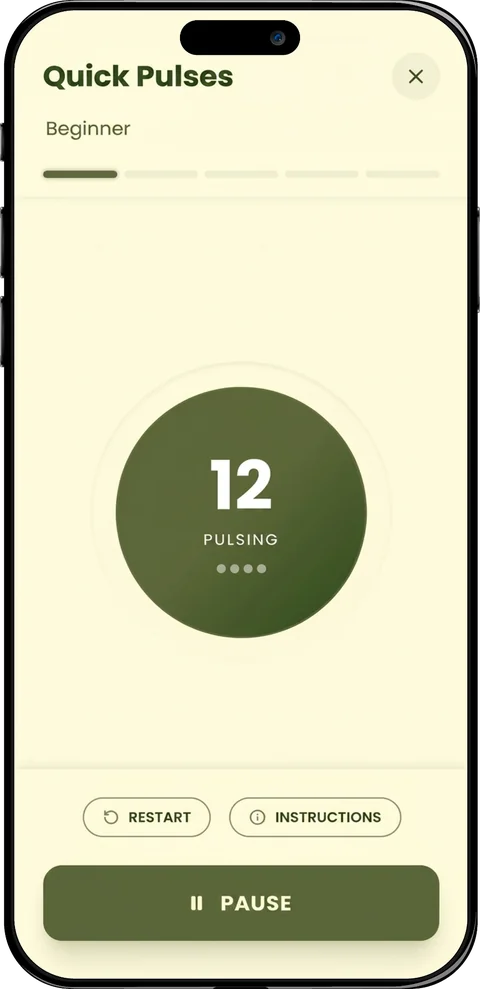
A prescribed exercise only works if it is done every day, the right way. Ritmo, a guided training app for iPhone and Android, shows on screen when to contract, hold and release, vibrates at every phase change and builds a 5 to 10 minute daily plan from a short questionnaire. It is on the App Store and Google Play.
The problem with prescribed Kegels: nobody knows if the patient trained
Pelvic floor exercise has a quirk that makes the doctor's job harder. The muscle is not visible from the outside, and almost nobody learns to contract it correctly on the first try. Glutes, abs and thighs join in, the patient feels effort and thinks he is training. Without someone checking, the mistake can go unnoticed for weeks.
The second difficulty is consistency. Pelvic training pays off with daily practice over months, and that is exactly the part that disappears first. No pain reminds the patient to train, there is no gym schedule, and the printed sheet ends up in a drawer. When he comes back, the doctor has no way to tell whether a weak result came from the method or from a lack of practice.
A guided training app tackles both. It tells the patient what to do at every second of the session and records what was done. Studies of pelvic floor apps show that this changes adherence.
98.4% were still training
three months after starting, in the group that trained the pelvic floor guided by a phone app, and 41% trained every day. The Swedish randomized trial followed 123 women with stress urinary incontinence; the app group improved symptoms and quality of life compared with the group that waited. The authors conclude that the app may increase adherence to pelvic floor training. The study was done in women, but the problem it measures, keeping up with the exercise, is the same in men.
Asklund I, Nyström E, Sjöström M, Umefjord G, Stenlund H, Samuelsson E. Mobile app for treatment of stress urinary incontinence: a randomized controlled trial. Neurourology and Urodynamics. 2017;36(5):1369-1376. DOI: 10.1002/nau.23116
Guided training works better than training on your own
In men, the most cited evidence on pelvic floor exercise for erections comes from a British trial in men with erectile dysfunction. The detail that matters for the clinic is the format: participants did not just get a recommendation. They got technical guidance on how to contract and a daily program to follow.
75.5% improved their erections
among the 55 men with erectile dysfunction who did guided pelvic floor exercises: 3 out of 4. And 40% (4 out of 10) regained normal erectile function within 6 months. The group that only got lifestyle advice fell behind until it started training.
Dorey G, Speakman M, Feneley R, Swinkels A, Dunn C. Pelvic floor exercises for erectile dysfunction. BJU International. 2005;96(4):595-597. DOI: 10.1111/j.1464-410X.2005.05690.x
The men had guidance and regular practice, and that is how the result showed up. It is the same reasoning that makes a urologist want the patient in a structured program rather than leaving him with "do your Kegels".
How it works day to day in the clinic
The flow is simple, and the doctor does not need to build or adjust any session.
- The doctor recommends it. During the visit, the urologist suggests Ritmo and gives the patient their patient link, which connects the patient's sign-up to the doctor.
- The patient answers the questionnaire. The app builds the plan around his goal and starting point, with 5 to 10 minute sessions a day.
- The patient authorizes the follow-up. Before any data reaches the doctor, he sees what will be shared and gives consent. Without that step, nothing is sent.
- The patient trains. The screen shows when to contract, hold, release and rest, with a vibration at every phase change. There is nothing to count and nothing to remember.
- The doctor follows along. He sees training frequency, the streak of days and progress through the program, and uses it at the next visit: if results came, he knows the patient trained; if they did not, he knows whether the problem was the method or consistency.
That last part changes the conversation too. The patient knows the doctor will see whether he trained, and knowing that helps him not push the day's session to tomorrow.
When urologists recommend it
Pelvic floor training shows up in several areas of men's urology. The most common:
- Erectile dysfunction. The ischiocavernosus and bulbocavernosus muscles help maintain pressure inside the penis during an erection. Training adds to what the doctor prescribes, tadalafil included, without replacing it. The reasoning is in erectile dysfunction and exercises.
- Premature ejaculation. Here control is what matters: knowing how to contract and, above all, how to release. How training fits in is covered in premature ejaculation and natural treatment.
- After prostatectomy. Pelvic floor training is the indication with the strongest evidence for regaining continence, always with clearance from the medical team. What the trials show is in Kegels after prostatectomy.
In all of these cases the app is the execution tool. Diagnosis, medication and treatment decisions stay with the doctor.
How Ritmo applies this in practice
Ritmo is a guided male pelvic floor training app for iPhone and Android. Each session is a sequence of 4 to 7 exercises, with a rest screen between them, and lasts 5 to 10 minutes. During an exercise the screen shows the timer and the phase, contract, hold, release or rest, and the phone vibrates at every change. The patient follows the rhythm without counting reps or guessing when to let go.
The program alternates two sessions of equal weight. Session A trains strength and endurance; Session B trains control and coordination. Progression is automatic, with rest days already in the plan, and the weekly Strength Test shows progress from one week to the next. Short lessons explain the why behind each stage. The app icon is discreet and sessions can be done anywhere, with no equipment.
That daily record, with the patient's consent, is what reaches the doctor as training frequency, streak of days and progress through the program.
Frequently asked questions
Do urologists recommend an app for Kegel exercises?
They do. Urologists and clinics already use Ritmo in the treatment of patients who need to train the pelvic floor, such as in erectile dysfunction, premature ejaculation and recovery after prostatectomy. The app guides every session and, with the patient's consent, the doctor can see whether the training is getting done.
What can my doctor see about my training in Ritmo?
With your consent, the doctor follows your training frequency, your streak of days and your progress through the program. Before any data is shared, you see what will be sent and authorize it. Without that authorization, nothing reaches the doctor.
Why train with an app instead of following an exercise sheet?
Because the weak point of prescribed Kegels is execution: wrong technique and irregular practice. In a randomized trial of a pelvic floor training app (Asklund 2017), 98.4% of participants were still training after three months and 41% trained every day. The app shows every phase and records every session.
Does guided pelvic floor exercise work for erectile dysfunction?
There is evidence for it. In the Dorey (2005) trial, 75.5% of the 55 men with erectile dysfunction who did guided pelvic floor exercises improved their erections, and 40% regained normal erectile function within 6 months. Training adds to the urologist's treatment without replacing it.
Does the app replace seeing a urologist?
No. Ritmo handles the daily execution of pelvic floor training. Diagnosis, tests, medication and treatment decisions stay with the doctor, who can use your training data, with your consent, to assess progress between one appointment and the next.
Is there an app for the Kegel exercises my urologist recommended?
Yes. Ritmo is a guided male pelvic floor training app for iPhone and Android. The screen shows when to contract, hold and release, the phone vibrates at every phase change and the plan has 5 to 10 minute sessions a day. It is on the App Store and Google Play. It does not replace medical care.
Conclusion
Pelvic floor exercise has evidence for erections, ejaculatory control and recovery after prostate surgery. Where it tends to fail is between one appointment and the next: wrong technique, irregular practice and no data for the doctor to review. That is why urologists and clinics started recommending guided training on the phone and following, with consent, whether the patient is actually training.
If your doctor recommended pelvic floor exercises, Ritmo takes care of daily execution: it shows every phase, keeps time and records every session. Your doctor stays in charge of the diagnosis and the plan.