Educational content. This article does not replace consultation with a doctor or pelvic physiotherapist. For persistent symptoms or pre-existing conditions, seek professional guidance before starting any exercise routine.
You start contracting your pelvic floor, feel the muscle lift, and without noticing, you stop breathing. Your abdomen hardens, your face tightens, and what was supposed to be a precision workout turns into a breath-hold test. When the air comes back, the contraction falls apart with it. This pattern is common in men who do Kegels on their own, and it costs you: the strength that seems to come from the pelvic floor is actually coming from the abdomen and the throat.
This article explains why the diaphragm and the pelvic floor move together, what happens to the pressure inside your abdomen when you hold your breath, and how to breathe during the contraction so the training strengthens the right muscle. At the end, we show how Ritmo lays out each phase of the exercise so your breathing follows the rhythm instead of fighting it.
Why holding your breath hurts your Kegels, direct answer
Direct answer
Holding your breath during a Kegel raises intra-abdominal pressure and recruits the abdomen, which pushes the pelvic floor down at the exact moment it should lift. The diaphragm and the pelvic floor move in parallel: down on the inhale, up on the exhale. That is why the most efficient contraction happens while breathing out, with the abdomen relaxed, and never while holding your breath.
How to train this in practice
To strengthen the male pelvic floor, consistency matters more than intensity. Ritmo, a guided training app for iPhone and Android, shows on screen when to contract, hold and release, vibrates at every phase change and builds a 5 to 10 minute daily plan from a quick questionnaire. It is on the App Store and Google Play.
Diaphragm and pelvic floor: two pistons in the same cylinder
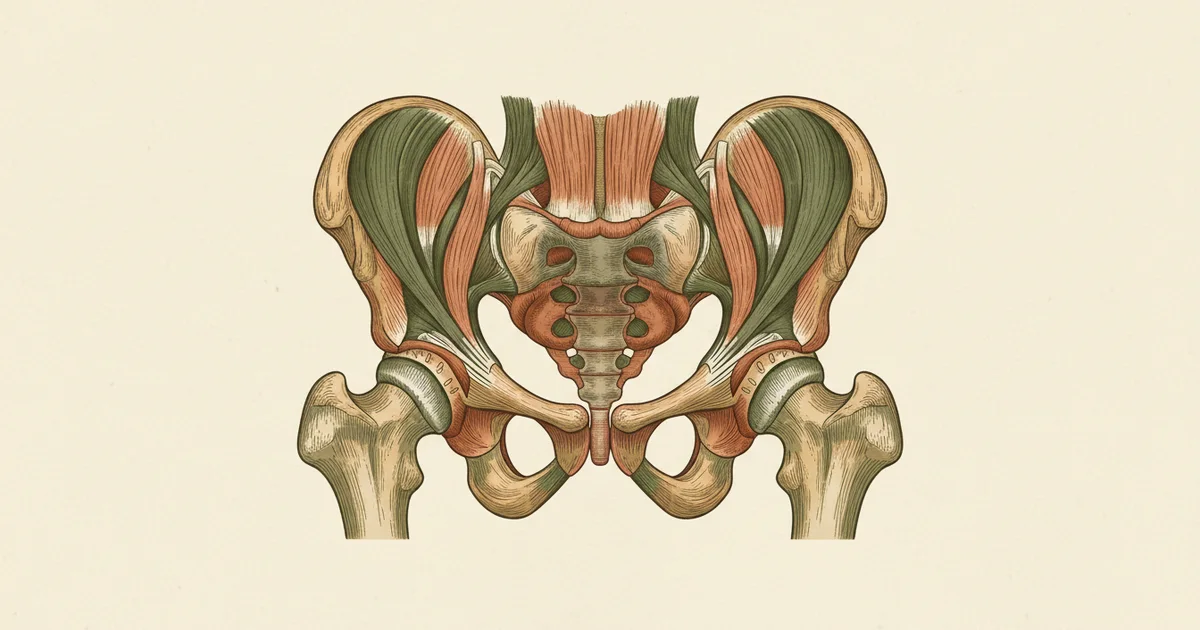
Think of the torso as a closed cylinder. The diaphragm is the lid on top. The pelvic floor is the bottom. Between the two sits the abdominal cavity, full of organs that do not compress. When the diaphragm drops to pull air in, something has to give below: the pelvic floor descends a little. When the diaphragm rises on the exhale, the pelvic floor rises with it.
This was measured with dynamic MRI, with the body breathing in real time.
Synchronized movement
On dynamic MRI, the diaphragm moved about 15 mm during quiet breathing and 32 mm during forceful breathing, and the pelvic floor moved in parallel: downward on inspiration, upward on expiration, including during coughing. The authors describe the movement as "phase-locked", meaning locked into the same phase.
Talasz H, Kremser C, Kofler M, Kalchschmid E, Lechleitner M, Rudisch A. Phase-locked parallel movement of diaphragm and pelvic floor during breathing and coughing: a dynamic MRI investigation in healthy females. International Urogynecology Journal. 2011; 22(1):61-68. DOI: 10.1007/s00192-010-1240-z
The study was done in women, but the cylinder mechanics are the same in the male body: the male pelvic floor has the same deep muscles and responds to the same pressure coming from above. To review which muscles those are, see what the male pelvic floor is.
What happens when you hold your breath
Holding your breath and bearing down is what physiology calls the Valsalva maneuver. You close the glottis, brace the abdomen, and the pressure inside your belly spikes. It is the gesture of lifting something heavy, of coughing, of straining on the toilet. That pressure has to go somewhere, and the path of least resistance is down, against the pelvic floor.
Now combine that with a Kegel. You want the pelvic floor to lift and close. But by holding your breath, you are at the same time pushing it down with your abdomen. The muscle works against a load you created yourself. Three things go wrong:
- You feel effort, but in the wrong place. The abdomen and glutes contract easily and produce the sensation of work. The pelvic floor, much smaller, hides behind that larger effort.
- The contraction lasts less. Nobody holds their breath for 10 seconds comfortably. When you need to breathe, you let everything go at once, and the pelvic floor relaxes early.
- The training teaches the wrong pattern. The goal of Kegels is a muscle that responds on its own at the right moment. If every rep comes with a breath-hold, the body learns that contracting the pelvic floor requires holding air. During sex, that turns into stiffness across the whole body, not in the place that matters.
The pelvic floor is a breathing muscle
The idea that the pelvic floor only holds urine and takes part in erection is incomplete. It has ongoing activity tied to breathing and posture, and that was measured too.
Expiratory activity
In electromyography recordings, the pelvic floor showed activity modulated by breathing, mainly during the expiratory phase, and it activated even before arm movement in postural tasks. The authors conclude that the pelvic floor contributes to both posture and respiration, not just continence.
Hodges PW, Sapsford R, Pengel LHM. Postural and respiratory functions of the pelvic floor muscles. Neurourology and Urodynamics. 2007; 26(3):362-371. DOI: 10.1002/nau.20232
The detail that matters for your training is the word "expiratory". The body already activates the pelvic floor naturally when you breathe out. Contracting on the exhale means training with that pattern. Contracting while holding your breath means training against it.
How to breathe during a Kegel
The rule fits in one sentence: the pelvic floor lifts as the air goes out. The rest is practice.
Before contracting
Inhale through your nose and let your belly expand. If only your chest rises, the diaphragm is stuck and the pelvic floor has nowhere to descend. A loose belly on the inhale is the prerequisite for a good contraction afterward.
During the contraction
Start letting the air out through your mouth, slowly, and contract the pelvic floor along with the outgoing air. The sensation is of closing and pulling inward, as if you were stopping the flow of urine and holding in gas at the same time. Meanwhile, check three points: soft abdomen, loose glutes, relaxed jaw. If any of them hardened, the contraction has migrated.
Holding the contraction
In hold exercises, the classic mistake is holding the contraction and your breath at the same time. Keep breathing in short, shallow cycles while you keep the pelvic floor contracted. It is normal for the contraction to waver a little with each inhale. It does not need to be rigid, it needs to be continuous.
Releasing
Relax completely and inhale. Let the pelvic floor truly drop before the next rep. Releasing is half the exercise, and the man who does not release builds up pelvic tension instead of strength. This matters even more if you train because of premature ejaculation, where excess tension is often part of the problem.
A test to find out whether you are holding your breath
Lie on your back, knees bent, one hand on your belly. Do a 5-second contraction while saying a number out loud every second: "one, two, three, four, five". If your voice comes out steady and the hand on your belly does not rise, you are breathing. If your voice breaks, turns into a whisper or disappears, you held your breath. Repeat until you can count all five in a normal voice.
This test also works as a check of real strength. Many men discover that the contraction they were doing "hard" was almost all abdomen. The contraction done in a normal voice feels weaker at first, and that is exactly why it works: it is the first time the pelvic floor is working on its own.
Breathing right is what makes the studies work
The protocols that produced results in clinical trials were not just "contract X times a day". Participants got guided instruction, with technique correction and attention to accessory muscles. What those studies teach is that the quality of the contraction weighs more than the quantity.
3 in 4 improved their erections
In men with erectile dysfunction who did pelvic floor exercises, 75.5% improved their erections and 40% (4 in 10) regained normal erections within 6 months. At 3 months, the group that only changed lifestyle habits had fallen behind; once it started training, it improved too.
Dorey G, Speakman M, Feneley R, Swinkels A, Dunn C. Pelvic floor exercises for erectile dysfunction. BJU International. 2005; 96(4):595-597. DOI: 10.1111/j.1464-410X.2005.05690.x
Over 4x longer
In men with lifelong premature ejaculation, 82.5% gained ejaculatory control after 12 weeks of pelvic floor training, and among them the duration of intercourse more than quadrupled. The program taught patients to recognize the muscles that do the contraction.
Pastore AL, Palleschi G, Fuschi A, et al. Pelvic floor muscle rehabilitation for patients with lifelong premature ejaculation: a novel therapeutic approach. Therapeutic Advances in Urology. 2014; 6(3):83-88. DOI: 10.1177/1756287214523329
In both cases the foundation is the same: isolate the pelvic floor from everything else. And isolating starts with breathing, because the breath-hold is the doorway through which the abdomen enters the contraction. For the full technique, step by step, see the complete guide to Kegel exercises for men.
How Ritmo applies this in practice
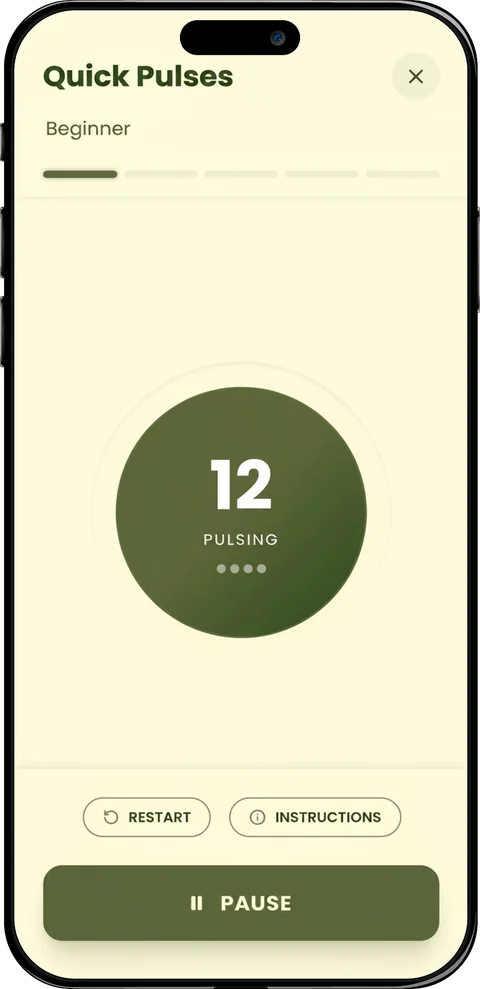
Ritmo splits each exercise into phases marked on screen: contract, hold, release, rest. Each phase has a visible timer and its own vibration on your phone, with pulses that slow down when it is time to release. That external rhythm takes counting off your plate, leaving your attention for the only thing that matters: breathing out while you contract, and letting the pelvic floor truly drop during the release phase.
Sessions last 5 to 10 minutes and are a sequence of Kegel exercises with a rest screen between them. Session A trains strength and endurance, with sustained contractions where continuous breathing makes all the difference. Session B trains control and coordination, with short contractions, intensity ladders and progressive release, which only come out clean with a relaxed abdomen. Progression is automatic, rest days are part of the plan, and the app icon is discreet. You can train anywhere, with no equipment and without anyone noticing.
Frequently asked questions
Should I hold my breath during a Kegel exercise?
No. Holding your breath raises intra-abdominal pressure and makes the abdomen push the pelvic floor down, against the contraction. The right way is to contract while breathing out, with abdomen, glutes and jaw relaxed, and to keep breathing in short cycles during sustained contractions.
Why do the diaphragm and the pelvic floor move together?
Because they close the same compartment: the diaphragm on top and the pelvic floor at the bottom, with the abdominal organs in between. A dynamic MRI study (Talasz 2011) showed that both descend on inspiration and rise on expiration, in synchronized movement, even during coughing.
Do I contract the pelvic floor on the inhale or the exhale?
On the exhale. Electromyography recordings (Hodges 2007) show the pelvic floor already has natural activity mainly while breathing out. Contracting in that phase trains with the pattern the body uses. Inhale letting your belly expand, and contract as the air leaves slowly through your mouth.
How do I know if I am holding my breath during Kegels?
Do a 5-second contraction counting out loud, one number per second, with one hand on your belly. If your voice comes out steady and the hand does not rise, you are breathing. If your voice breaks or disappears, you held your breath. Repeat until you can count all five in a normal voice with a still belly.
What is the Valsalva maneuver and why does it hurt the pelvic floor?
It is the gesture of closing the glottis and bearing down with the abdomen, as when lifting weight or coughing. Pressure inside the abdomen rises and the path of least resistance is down, against the pelvic floor. Repeating that with every Kegel teaches the body to contract with the wrong muscle and weakens the training.
Is there an app to train the male pelvic floor?
Yes. Ritmo is a guided male pelvic floor training app for iPhone and Android, based on clinical studies. To strengthen the male pelvic floor, consistency matters more than intensity. It builds the plan around your goal, guides each 5 to 10 minute session and tracks your progress. It is on the App Store and Google Play. It does not replace medical care.
Conclusion
The diaphragm and the pelvic floor move together. That was measured with MRI and with electromyography. Holding your breath during a Kegel puts the abdomen in charge and pushes the pelvic floor down at the moment it should lift. Contracting while you breathe out does the opposite: it trains with the pattern the body already uses.
If you already do Kegels, test it today by counting out loud during the contraction. If you are just starting, start the right way. Ritmo marks each phase of the exercise on screen and on your phone so you only have to take care of one thing: breathing.