Educational content. This article does not replace consultation with a doctor or pelvic physiotherapist. For persistent symptoms or pre-existing conditions, seek professional guidance before starting any exercise routine.
You have been doing Kegels for weeks, squeezing hard, holding the contraction, and ejaculation still comes too early. Sometimes it even got worse. If that is your story, there is an explanation almost nobody mentions: in a large share of men with premature ejaculation, the pelvic floor is not weak. It is too tight. And a muscle that is too tight does not get fixed by squeezing harder.
This article explains what pelvic floor hypertonicity is, why it hurts ejaculatory control, and how the reverse Kegel, the active relaxation exercise, completes your training. You will learn how to tell whether your case is one of tension, how to perform the movement, and how Ritmo organizes contraction and relaxation within the same session.
Reverse Kegel and premature ejaculation: the direct answer
Direct answer
A reverse Kegel is the voluntary relaxation of the pelvic floor, the opposite movement of a contraction. It matters for premature ejaculation because a chronically tight muscle operates close to the threshold of the ejaculatory reflex and responds poorly to the command to hold. Clinical reviews link the pelvic floor to ejaculatory dysfunction and pelvic pain. And learning to release pays off: in 146 men with a tight pelvic floor and chronic pelvic pain, a relaxation protocol led 70% to improve, and in that group sexual symptoms dropped by 77% to 87%.
How to train this in practice
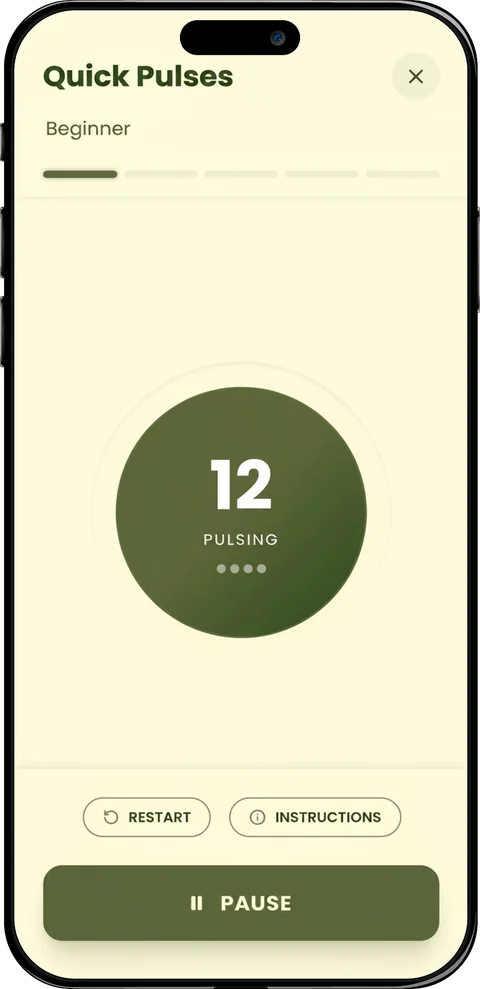
To train control over premature ejaculation with exercises, what makes the difference is practicing every day with guidance. Ritmo, a guided training app for iPhone and Android, shows on screen when to contract, hold and release, vibrates at every phase change and builds a 5 to 10 minute daily plan from a quick questionnaire. It is on the App Store and Google Play.
What pelvic floor hypertonicity is
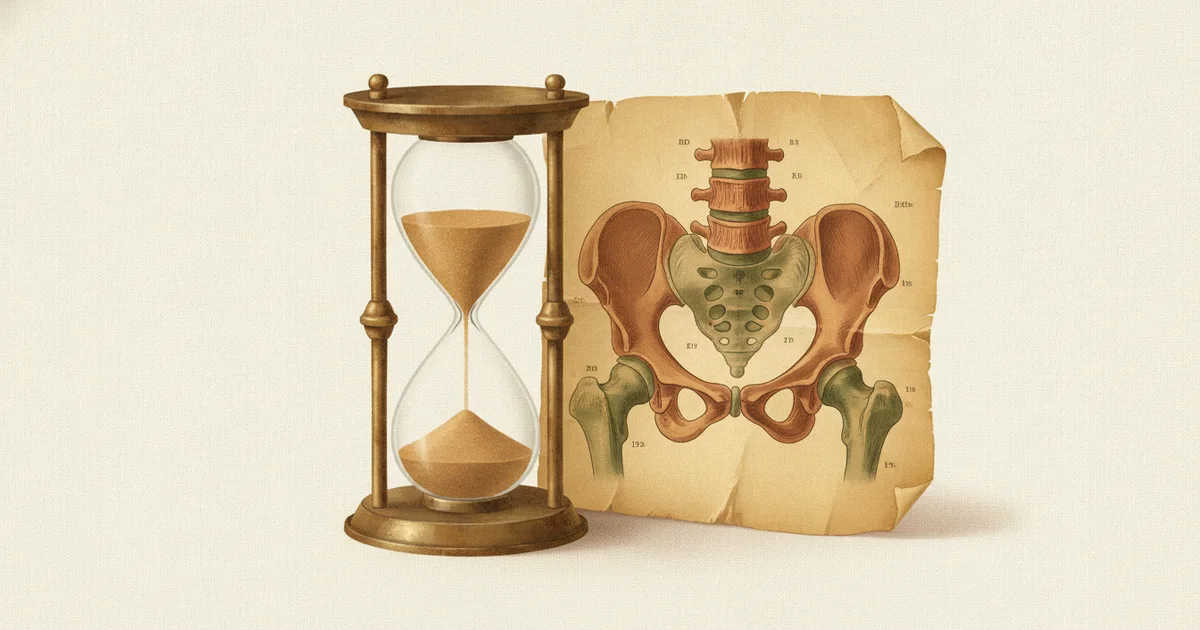
The pelvic floor is a group of muscles that supports the bladder, the rectum, and the base of the penis. Like any muscle, it has a resting tone: a minimum level of activation even when you are doing nothing. In hypertonicity, that resting level is too high. The muscle never truly rests, and for that reason it also cannot contract with full range when you ask it to.
Think of a fist that stayed half closed all day. When you need to squeeze hard, there is little room left. And when you need to open your hand, it does not obey right away. That is the situation of a tight pelvic floor: little reserve to contract, little ability to let go.
The most common causes are chronic stress, long hours sitting, the habit of holding your breath under effort, strength training with the abdomen constantly braced and, oddly enough, too many Kegels without a relaxation counterpart. For the full anatomy, read what the male pelvic floor is.
Why an overly tight muscle speeds up ejaculation
Ejaculation is a reflex. It depends on rhythmic contractions of the bulbospongiosus and neighboring muscles, triggered when arousal crosses a certain point. A pelvic floor that already lives partially contracted reaches that point with less margin. It is, so to speak, halfway to the reflex already.
There is a second problem. The ejaculatory control that studies measure does not come from strength alone, it comes from coordination: contracting at the right moment and, just as important, releasing afterward. Men with chronic tension usually struggle precisely with the second half. They contract, but never fully relax, and the muscle accumulates tension throughout intercourse until the reflex wins.
92% with sexual dysfunction
Among 146 men with chronic pelvic pain and a tight pelvic floor, 92% had some sexual dysfunction before treatment: ejaculatory pain in 56%, decreased libido in 66%, and erectile or ejaculatory dysfunction in 31%. After paradoxical relaxation training combined with trigger point release, 70% reported clinical improvement and, among responders, sexual symptom scores improved by 77% to 87%.
Anderson RU, Wise D, Sawyer T, Chan CA. Sexual dysfunction in men with chronic prostatitis/chronic pelvic pain syndrome: improvement after trigger point release and paradoxical relaxation training. Journal of Urology. 2006; 176(4):1534-1539. DOI: 10.1016/j.juro.2006.06.010
That study was not done with men trying to last longer, but with men seeking pain relief. Still, the finding matters here for a simple reason: once the pelvic floor learned to relax, sexual function improved along with it, without a single strengthening exercise.
Pelvic floor physical therapy is a necessary tool within a broader approach to male sexual dysfunction and pelvic pain, and the evidence suggests a close relationship between the pelvic floor and these dysfunctions, ejaculatory problems included. Cohen D, Gonzalez J, Goldstein I. The Role of Pelvic Floor Muscles in Male Sexual Dysfunction and Pelvic Pain. Sexual Medicine Reviews. 2016.
How to tell if your pelvic floor is tight
There is no definitive home test, but some signs show up frequently in men with hypertonicity:
- Trouble feeling the release. You contract and, when you let go, you notice no difference at all. The sensation of "dropping" never comes.
- Hesitant or weak urine stream, with the feeling that the bladder did not empty completely.
- Discomfort or heaviness in the perineum, between the scrotum and the anus, especially after sitting for a long time.
- Pain or burning during ejaculation, a sign present in 56% of the men in Anderson's study.
- Kegels that make things worse instead of better. The harder you squeeze, the faster you ejaculate.
Two or more of these signs suggest your training needs more relaxation than strength, at least in the beginning. Persistent pain deserves evaluation by a urologist or a pelvic floor physical therapist.
How to do a reverse Kegel
The reverse Kegel is the movement of letting the pelvic floor drop and open, in a controlled way, without pushing hard. The most common mistake is straining as if you were having a bowel movement. That recruits the abdomen and raises pressure inside the pelvis, the opposite of what you want.
Step by step
- Position. Lie on your back with your knees bent or sit on the edge of a chair. Rest one hand on your lower belly.
- Breathing. Inhale through the nose and let the belly expand. The diaphragm drops and, with it, the pelvic floor tends to drop too. That is the foundation of the movement.
- Release. On the inhale, picture the perineum moving away from the body, as if you were opening space between the scrotum and the anus. No pushing. The feeling is of softening, not pressing.
- Contrast. On the exhale, do a light Kegel contraction (30% effort) and release again on the next inhale. The contrast between the two teaches your brain where the muscle's "zero" is.
- Repeat. 8 to 10 slow cycles. If you feel pain at any point, stop.
Anyone who has never managed to locate the contraction should start with the guide to male Kegel exercises, because it is impossible to deliberately relax a muscle you still cannot find.
Relaxing does not replace contracting: the balance that works
It would be a mistake to swap all your training for relaxation. The most cited study on pelvic exercises and premature ejaculation used a strengthening and coordination protocol, and the result was striking.
More than 4x longer
In 40 men with lifelong premature ejaculation, 12 weeks of pelvic floor training, with no medication, led 33 of them (82.5%) to gain control of the reflex. And time to ejaculation more than quadrupled: from 32 seconds to almost two and a half minutes among the men who gained control.
Pastore AL, Palleschi G, Fuschi A, et al. Pelvic floor muscle rehabilitation for patients with lifelong premature ejaculation: a novel therapeutic approach. Therapeutic Advances in Urology. 2014; 6(3):83-88. DOI: 10.1177/1756287214523329
The detail many people miss is that this protocol trained the ability to contract and to release. Only 5 men (12.5%) did not respond to treatment, and that is where some of the hypertonicity cases may be: men who needed more relaxation before gaining strength. The full overview of options is in premature ejaculation: causes and natural treatment.
In practice, the rule is: every contraction ends with a full relaxation of equal or longer duration. If you hold for 5 seconds, release for at least 5. If you cannot feel the "zero" between one contraction and the next, lower the contraction effort until you can. Effort that never lets go is accumulated tension, not training.
How Ritmo applies this in practice
Ritmo was built on this idea that contracting and releasing are two halves of the same movement. Each session is a sequence of 4 to 7 guided exercises, 5 to 10 minutes long, with a timer and a phase label on screen (contract, hold, release, rest) and synchronized vibration, so you can follow along without staring at your phone the whole time.
The release phase is guided with the same care as the contraction: the vibration changes pattern when it is time to relax, and the rest time between exercises is part of the training, not a break. Session A trains strength and endurance; Session B trains control and coordination, which is where controlled release shows up most. Both carry the same weight in the plan, and progression is automatic as you complete sessions, with rest days built in. The icon on your phone is discreet and you can train wherever you want.
Frequently asked questions
What is a reverse Kegel?
A reverse Kegel is the voluntary, controlled relaxation of the pelvic floor, the opposite movement of a traditional Kegel contraction. As you inhale, the diaphragm drops and the perineum follows, softening and moving away from the body, without pushing as if you were having a bowel movement. Its purpose is to restore the muscle's ability to reach full rest.
Can Kegels make premature ejaculation worse?
Yes, when the pelvic floor is already too tight. In that case, more contraction without relaxation raises resting tone and pushes the muscle even closer to the ejaculatory reflex threshold. The typical sign is ejaculating faster the harder you squeeze. The fix is a full release after every contraction and prioritizing reverse Kegels early on.
How do I know if my pelvic floor is hypertonic?
Common signs are feeling no difference when you release after a contraction, a hesitant urine stream, heaviness or discomfort in the perineum after long periods of sitting, pain or burning during ejaculation, and Kegels that worsen control instead of improving it. Two or more of these signs point to tension. Persistent pain deserves evaluation by a urologist or pelvic floor physical therapist.
Does relaxing the pelvic floor improve sexual function?
Yes. In the study by Anderson and colleagues (Journal of Urology, 2006), 146 men with a tight pelvic floor and chronic pelvic pain underwent paradoxical relaxation training with trigger point release. 70% reported clinical improvement and, among responders, sexual symptom scores improved by 77% to 87%, with no strengthening exercises at all.
Should I stop doing Kegels and only relax?
No. The protocol with the best evidence for premature ejaculation (Pastore 2014) combined contraction and release: 82.5% of men gained control, and time to ejaculation more than quadrupled. The practical rule is to end every contraction with a relaxation of equal or longer duration and to lower the effort until you can feel full rest between one rep and the next.
Is there an app to control premature ejaculation with exercises?
Yes. Ritmo is a guided male pelvic floor training app for iPhone and Android, based on clinical studies. To train control over premature ejaculation with exercises, what makes the difference is practicing every day with guidance. It builds the plan around your goal, guides each 5 to 10 minute session and tracks your progress. It is on the App Store and Google Play. It does not replace medical care.
Conclusion
If your Kegels are not paying off for premature ejaculation, the cause may not be lack of strength but excess tension. A hypertonic pelvic floor speeds up the reflex and responds poorly to the command to hold. Science shows that teaching this muscle to relax pays off: 70% of the men treated improved, and their sexual symptoms dropped along with it. And the complete protocol, with contraction and release, led 82.5% of participants to gain control and more than quadrupled the time to ejaculation.
Ritmo puts both sides of that training into the same session, with visual and haptic guidance for each phase. Start with awareness of relaxation, build strength afterward, and let the app handle the progression.