Educational content. This article does not replace consultation with a doctor or pelvic physiotherapist. For persistent symptoms or pre-existing conditions, seek professional guidance before starting any exercise routine.
You read about Kegels, saw that the exercise is simple and started doing them on your own. You squeeze in the car, you squeeze before bed, sometimes you remember, sometimes you forget. A few weeks later the doubt shows up: is this working? You do not feel any difference in control, firmness is the same and you cannot even tell whether you are squeezing the right muscle.
Most of the time, what fails is the execution. This article covers the 7 most common mistakes men make when training the pelvic floor on their own, how to spot each one and what to do instead. At the end, it shows how Ritmo structures training so these mistakes do not happen.
The most common Kegel mistakes, the short answer
Short answer
The most common mistakes when doing Kegels alone are: squeezing the glutes, abs or thighs instead of the pelvic floor; holding your breath; not fully releasing the muscle between contractions; doing too many contractions; always training the same way; never increasing the difficulty; and training inconsistently. Fixing technique and organizing training into short daily sessions makes more difference than adding more reps.
How to train this in practice
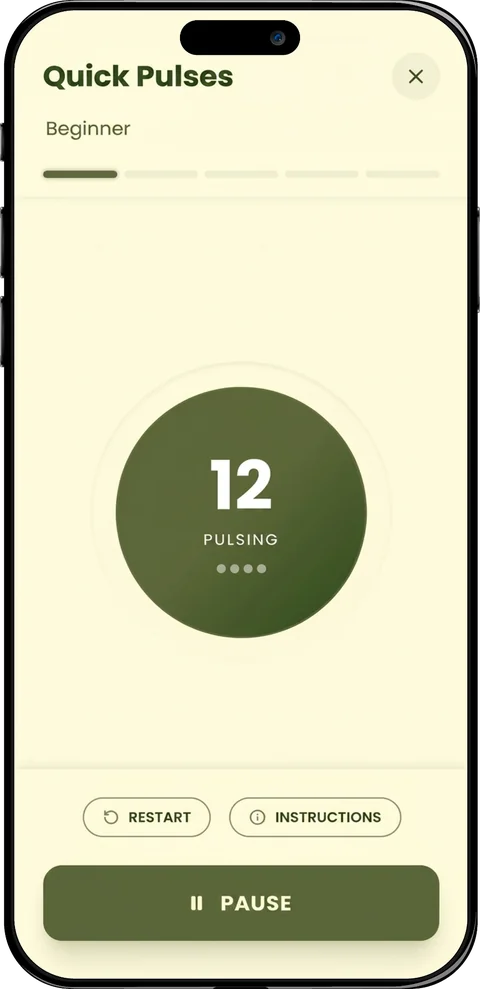
Most of these mistakes come from training without a reference for timing, load and rest. Ritmo, a guided training app for iPhone and Android, shows on screen when to contract, hold and release, vibrates at every phase change and builds a 5 to 10 minute daily plan from a quick questionnaire. It is on the App Store and Google Play.
Mistake 1: squeezing the wrong muscle
The pelvic floor is hidden. It closes the bottom of the pelvis, between the pubic bone and the tailbone, and you cannot see it from the outside. That is why beginners training alone tend to squeeze what they can feel: the glutes, the inner thighs or the abs. It feels like effort, but the muscle that matters barely works.
The right contraction is small. The base of the penis pulls slightly into the body and the area between the anus and the scrotum lifts. Hips still, glutes loose, belly soft. If your body moves, extra muscles are helping. The guide on how to know if you are squeezing the right muscle has simple tests to check.
Mistake 2: holding your breath
When holding a contraction, a lot of men lock their breath without noticing. The problem is that holding your breath raises the pressure inside the abdomen, and that pressure pushes the pelvic floor down. You are trying to lift the muscle while your own body pushes the opposite way.
The right approach is to breathe normally through the whole exercise. If you cannot hold the contraction while breathing, it is too strong for your current level. Lower the intensity and keep the air moving. The article on breathing and the pelvic floor explains how the diaphragm and pelvic floor work together.
Mistake 3: not fully releasing
A Kegel has two halves: contract and release. Men training alone tend to pay attention only to the first. They squeeze, hold and go straight into the next contraction with the muscle still half on.
A pelvic floor that never relaxes stays tense, tires quickly and loses sensitivity. During sex this matters: a muscle that is already contracted all the time has nowhere to go when you need to hold back arousal. In some men with premature ejaculation, that is exactly the problem, and what is missing is learning to let go. The reverse Kegel covers that side of training.
Simple rule
Release for at least as long as you hold. If you hold for 5 seconds, release for 5 seconds or more, feeling the area drop and loosen before the next contraction.
Mistake 4: doing too much
Because the exercise is discreet, it is tempting to squeeze all day. Hundreds of reps, long sessions, training every hour. It looks like dedication, but a tired muscle loses technique: the contraction gets weak, the glutes jump in to help and the release disappears.
The pelvic floor responds like any other muscle. It needs stimulus and recovery. One short, well done session a day pays off more than hours of random squeezes. The article on how many Kegel reps per day goes into the right volume.
Mistake 5: always training the same way
Men who train alone usually pick one exercise and repeat it forever. It is usually holding a contraction for a few seconds. But the pelvic floor does different jobs, and each one needs a different kind of training.
- Strength. Strong, short contractions. This is what helps squeeze the base of the penis and keep blood in during an erection.
- Endurance. Longer, moderate contractions. This is what lets the muscle keep working until the end of sex.
- Control. Contracting and releasing with precision, at different speeds and intensities. This is what lets you notice arousal rising and hold back at the right moment.
Training only one of these leaves the others idle. The result shows up only halfway.
Mistake 6: never increasing the difficulty
At first, Kegels tend to feel encouraging, because the muscle starts to respond. Then, if the training stays the same, the body adapts and progress stalls. It is like doing the same set with the same weight at the gym for a year.
For the pelvic floor, difficulty goes up in a few ways: holding longer, doing more contractions per set, shortening rest and changing position. Lying down is the easiest position. Sitting and standing, the muscle works against your body weight, which is how it is used in daily life. The article on standing and sitting Kegels shows that progression.
Mistake 7: training inconsistently
The most common pattern for men doing Kegels alone goes like this: a week of enthusiasm, a few days of forgetting, a restart, and then the training fades away. The muscle never gets time to adapt, and the conclusion is that the exercise does not work.
Muscle strength comes from sessions adding up. A few minutes every day beats an hour now and then. Tying training to a fixed time, or to something that already happens every day, helps keep the habit. It is also worth adjusting expectations: the pelvic floor improves with steady training, with no shortcut. When it responds, you feel more control, firmer erections and more confidence, because you know where the muscle is and can use it.
What all these mistakes have in common
Almost all of them come from a lack of reference. On your own, nobody tells you how long to hold, when to release, how long to rest and when to raise the load. A training structure fixes most of them at once.
How Ritmo puts this into practice
Ritmo was built to take those decisions off your plate. You open the app, do the session of the day and it handles the rest.
- Guided training, visual and by vibration. During the exercise the screen shows the timer and the phase (contract, hold, release, rest) and the phone vibrates at every change. Release time is marked, so relaxing does not get skipped.
- 5 to 10 minute sessions. Each session has 4 to 7 exercises with a rest screen between them. The volume is already right.
- Session A and Session B. A trains strength and endurance, B trains control and coordination. Both carry the same weight in the program, which covers all three jobs of the muscle.
- Questionnaire-based plan and automatic progression. The plan is built from your answers and the difficulty goes up on its own as you progress.
- Weekly Strength Test. Once a week you measure your own strength and see whether the training is paying off.
- Streak, achievements and short lessons. The day streak helps you stay consistent, and the lessons explain technique in a few minutes. The icon is discreet on your phone screen.
Frequently asked questions
Why are Kegels not working for me?
Most of the time, because of execution. The most common reasons are squeezing the glutes or abs instead of the pelvic floor, holding your breath, not fully releasing the muscle and training inconsistently. Fixing technique and doing a short session every day usually helps more than adding reps.
How do I know if I am doing Kegels wrong?
Signs of poor execution: your hips move, your glutes squeeze, your belly hardens, you hold your breath or you feel fatigue in your back or thighs. The right contraction is small and does not show from the outside: the base of the penis pulls in slightly and the area between the anus and the scrotum lifts.
Can doing too many Kegels be bad?
It can get in the way. A tired muscle loses technique, the contraction weakens, other muscles step in to help and the pelvic floor can stay tense because it never relaxes. One short, well done session a day pays off more than hundreds of squeezes spread out with no rest.
Do I need to relax between Kegel contractions?
Yes. Releasing is part of the exercise. Rest time should be at least as long as the contraction, feeling the area drop and loosen. A pelvic floor that never lets go stays tense and loses control, which especially hurts men dealing with premature ejaculation.
Is one type of Kegel exercise enough?
No. The pelvic floor does three jobs: strength, endurance and control. Strong, short contractions train strength, long moderate ones train endurance, and contracting and releasing with precision trains control. Training only one of them leaves you with half the result.
Is there an app for doing Kegels without mistakes?
Yes. Ritmo is a guided male pelvic floor training app for iPhone and Android. It builds your plan from a questionnaire and guides each 5 to 10 minute session by showing on screen when to contract, hold and release, with a vibration at every phase change and difficulty that goes up on its own. It is on the App Store and Google Play. It does not replace medical care.
Conclusion
Kegels are simple to explain and easy to get wrong. If you have been training for a while and feel no difference, start with the first two mistakes: check that you are squeezing the right muscle and that you breathe during the contraction. Then look at the rest, especially releasing and consistency.
If you want to stop guessing, Ritmo organizes training into 5 to 10 minutes a day, wherever you want. The screen and vibration mark each phase, and the difficulty goes up as you progress.