Educational content. This article does not replace consultation with a doctor or pelvic physiotherapist. For persistent symptoms or pre-existing conditions, seek professional guidance before starting any exercise routine.
The desire is there. The person you wanted is right there. And right at that moment your head starts narrating: what if it doesn't get hard, what if it goes soft halfway, what if it happens again. The more attention you pay to your penis, the less it responds. Before long, nerves have become the main event of the night.
Losing an erection because of nerves is common, especially the first time with someone, after a while without sex or after a failure that stuck in your memory. It is not a flaw in you. This article explains why your head takes your body down, what to do before and during sex, and how pelvic floor training, guided by Ritmo, gives your body a response you can trust even when your mind is racing.
How to stop losing your erection from nerves, the short answer
Short answer
To stop losing your erection from nerves, move your attention off your penis and onto sensation, breathe slowly with a loose belly and do not try to force the erection. Nerves switch on the body's alarm system, which diverts blood and keeps the penis contracted. Over time, pelvic floor training helps because it gives you control over firmness and trust in your own body, which breaks the performance anxiety loop.
How to train this in practice
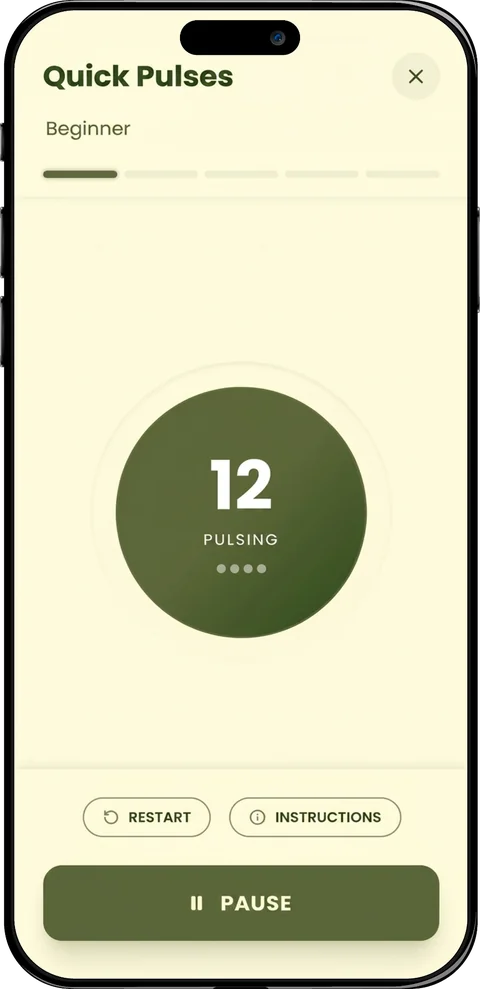
Part of the anxiety comes from not trusting your own body, and that trust can be trained. Ritmo, a guided training app for iPhone and Android, shows on screen when to contract, hold and release, vibrates at every phase change and builds a 5 to 10 minute daily plan from a quick questionnaire. It is on the App Store and Google Play.
Why nerves take your erection down
Erection depends on relaxation. For the penis to fill, the smooth muscle of the corpora cavernosa has to let go and let blood in. That is run by the parasympathetic side of the nervous system, the same side that works when you feel rested and safe.
Nerves switch on the opposite side, the sympathetic one. That is alarm mode: racing heart, short breaths, tense muscles, adrenaline in the blood. In that state, your body decides there is something more urgent than sex and cuts the flow to the penis. The penile muscle contracts, blood does not get in and the erection either does not come or does not last.
Your penis responds to the state of your body, and your desire is only one part of that. The article on stress, cortisol and sexual performance goes deeper into the hormonal and nervous side.
The detail most men miss
Desire and alarm compete for the same body. You can want it badly and be in threat mode at the same time. When alarm wins, the erection loses, no matter how strong the attraction is.
The performance anxiety loop
A single failure is almost never the problem. The problem is what it leaves behind. Next time, part of your attention leaves the moment and starts monitoring your body: is it getting hard? is it firm? will it last? Monitoring already is alarm, and alarm is what blocks the erection.
That closes the loop. Fear of failing, attention on the penis, alarm, failure, more fear. The more often it runs, the more automatic it gets. Many men start avoiding sex, making excuses or rushing to get it over with, and that reinforces the feeling that their body cannot be trusted.
Signs that nerves are the cause
- You get erections normally when masturbating or alone, but they fade with a partner.
- You wake up with morning erections fairly often.
- The problem shows up in new situations and improves when you feel at ease.
- The erection starts fine and drops when you think about it.
These signs point to the emotional side, but they do not replace an assessment. If the difficulty shows up in every situation, even alone, or if it keeps getting worse, see a urologist. There may be a physical cause worth looking into.
What to do in the moment
There is no trick that switches nerves off on the spot. You can take power away from them, though, because each of these moves pushes your body back toward relaxation mode.
Breathe slowly, from the belly
Breathing is the fastest way to shift your nervous system. A long exhale, longer than the inhale, with a loose belly tells your body there is no danger. Holding your breath does the opposite. The article on breathing and the pelvic floor explains why the two always work together.
Take your attention off your penis
Watching your erection is what gets in the way most. Bring your attention to what you feel: touch, skin, smell, what the other person is doing. Erection is a result of arousal, and arousal depends on being present, not on checking the result.
Do not rush
Rushing to penetration before your body is ready adds pressure. Longer foreplay gives your nervous system time to change modes. If the erection fades midway, that is normal and it usually comes back with more stimulation, as long as you do not panic.
Say it, if it makes sense
Saying you are nervous takes a huge weight off. The person next to you almost always reacts better than you expect, and the secret you were keeping stops taking up space in your head.
Why training your body helps your head
Nerves feed on doubt: I do not know if my body will respond. One way to weaken that doubt is to have a body you know and control. That is where the pelvic floor comes in.
The pelvic floor muscles wrap around the base of the penis. When they contract, they squeeze the veins that drain blood and help keep the erection firm. They also play a part in ejaculatory control. A man who trains these muscles knows where they are, feels when they are tense and can use them. The guide to exercises for erectile dysfunction covers that mechanism in detail.
Training also teaches you to release. Men who live on edge often carry pelvic tension without noticing, and a muscle that never relaxes hurts both erection and control. Learning to contract and release with precision is an exercise in body awareness, the same kind of awareness that pulls you out of self monitoring. The reverse Kegel works on that side.
What changes with training
With training, you start to feel the muscle respond when you call on it, you get more firmness and more control, and you trust your own body more. That trust matters in the moment: less room for doubt, less room for alarm.
How Ritmo applies this in practice
Ritmo organizes pelvic floor training so you do not have to think about anything other than doing today's session.
- Guided training, visual and by vibration. During each exercise the screen shows the timer and the phase (contract, hold, release, rest) and your phone vibrates at every change. You learn to feel the muscle and also to let it go.
- 5 to 10 minute sessions. Each session has 4 to 7 exercises with a rest screen between them, at your pace, wherever you want.
- Session A and Session B. A trains strength and endurance, B trains control and coordination. Both carry the same weight in the program.
- Questionnaire based plan and automatic progression. The plan comes from your answers, nerves included, and difficulty goes up as you progress.
- Weekly Strength Test. You see your own progress week by week, which helps you swap doubt for something you can measure.
- Short lessons, streaks and achievements. Lessons explain how your body works, and the day streak helps you keep the habit. The icon is discreet on your phone's home screen.
Frequently asked questions
Why do I lose my erection when I get nervous?
Because nerves switch on your body's alarm mode, the sympathetic nervous system. In that state the smooth muscle of the penis stays contracted and blood does not get into the corpora cavernosa. Erection needs the opposite side, the parasympathetic, which only works when your body feels safe.
How do I know if my erection problem is psychological?
Some signs point to nerves: you get erections normally alone or when masturbating, you wake up with morning erections fairly often and the problem shows up more in new situations. If the difficulty happens in every situation, even alone, see a urologist to look into a physical cause.
What can I do in the moment to avoid losing my erection from anxiety?
Breathe slowly with a loose belly, with the exhale longer than the inhale. Move your attention off your penis and onto sensation and the other person. Do not rush to penetration and, if it makes sense, say you are nervous. Each of these moves pushes your body back toward relaxation mode.
Does losing my erection once mean I have erectile dysfunction?
No. A single failure is common and is almost always about fatigue, alcohol or nerves. What deserves attention is when the difficulty keeps repeating or shows up in every situation. In that case, it is worth seeing a urologist.
Do Kegel exercises help men who lose erections from nerves?
They help in two ways. Training strengthens the muscles that squeeze the base of the penis and help keep it firm, and it also teaches you to release the pelvic tension that nerves build up. Over time you get to know and control your own body, which takes power away from the doubt that feeds anxiety.
Is there an app to train so nerves stop costing me my erection?
Yes. Ritmo is a guided male pelvic floor training app for iPhone and Android. It builds your plan from a questionnaire and guides each 5 to 10 minute session by showing on screen when to contract, hold and release, with a vibration at every phase change. It is on the App Store and Google Play. It does not replace medical care.
Conclusion
Losing your erection from nerves is your body obeying an alarm signal, not a defect. In the moment, breathe slowly, take your attention off your penis and do not rush. Outside the moment, work on what feeds the doubt: a body you do not know. If the problem happens every time, even alone, see a urologist.
To train the physical side, Ritmo guides your pelvic floor in 5 to 10 minutes a day, wherever you want. The screen and the vibration mark each phase, and you follow your progress in the Strength Test.